The Water You're Already Making and Throwing Away
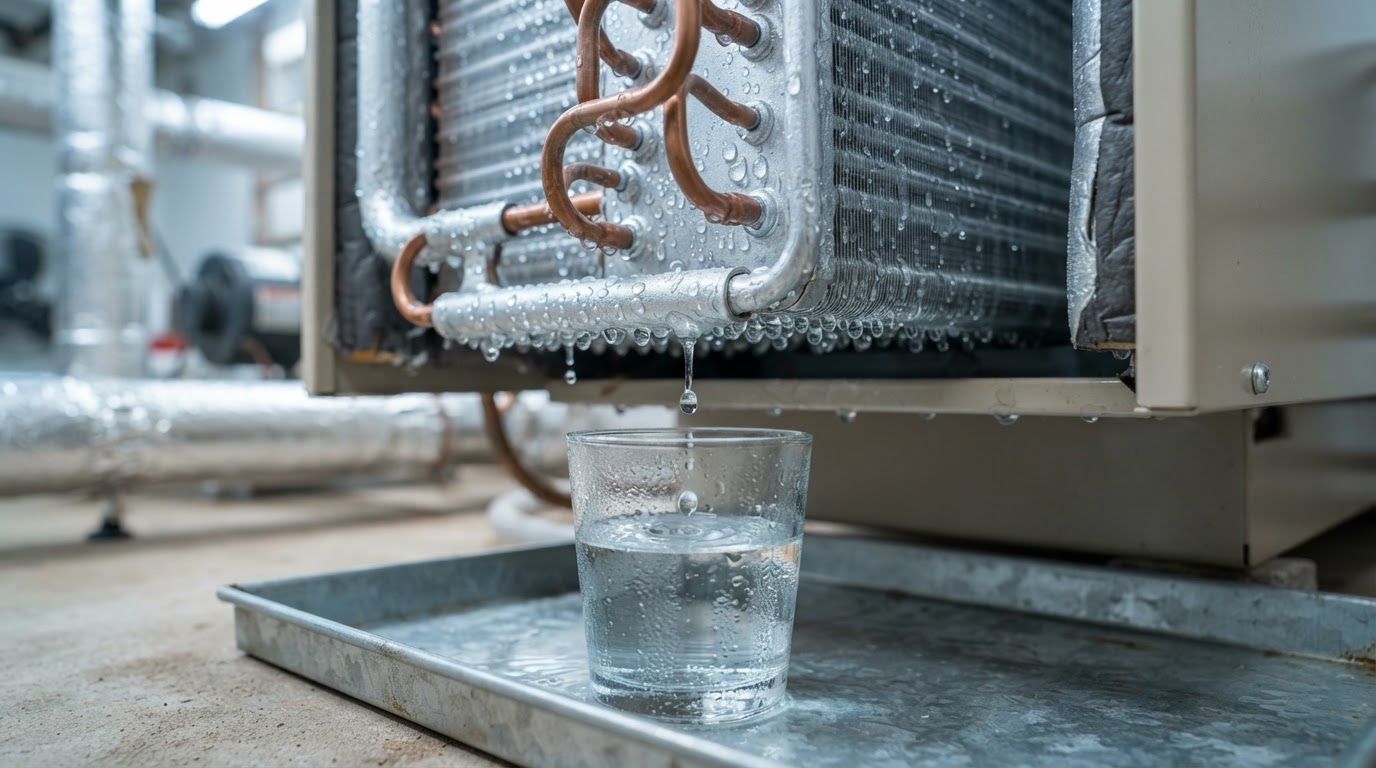
When your air conditioner runs, it pulls heat and humidity out of your home's air. That humidity condenses on the cold indoor coil — the same way a glass of ice water sweats on a summer afternoon — and the droplets run down into a drain pan and out a pipe to the outdoors or a floor drain. On a hot, humid day, a single residential unit can produce five to twenty gallons of that water, and a larger home or a long cooling season makes far more. Almost every homeowner sends it away without a second thought.
That's a quiet waste hiding in plain sight. The water leaving that drain line isn't wastewater. It's distilled-grade condensate — remarkably pure, naturally soft, and nearly free of the minerals that make municipal water hard on your fixtures and pipes. You're paying the utility for water while simultaneously manufacturing gallons of better water and discarding it.
Condensate catchment is simply the act of catching what you're already making. It doesn't require new equipment or a lifestyle change. It requires a drain line, a container, and the recognition that the stuff going down the drain is one of the cleanest water sources on your property.
Why Condensate Is Unusually Good Water
Because condensate forms by evaporating and re-condensing moisture from the air, it skips the mineral load that municipal and well water carry. It's low in calcium and magnesium — the culprits behind scale, soap scum, and shortened appliance life — which means it's naturally soft. Plants love it. Evaporative and cooling systems love it. And because it arrives without chlorine or treatment chemicals, it's gentler on everything it touches.
There's a catch worth respecting: condensate can be slightly acidic and may pick up trace metals from the coil or drain pan, so it's best used for non-potable purposes like irrigation, landscape watering, and cooling-tower or humidifier makeup unless you filter and test it for drinking use. Treat it like the high-quality utility water it is — capture it clean, route it to where soft water does the most good, and don't drink it without proper treatment.
The point isn't that condensate replaces your drinking water. The point is that for every gallon of irrigation or non-potable use you shift onto captured condensate, you save a gallon of utility water — water that's metered, billed, and increasingly expensive. Over a cooling season, that adds up to real money and real independence.
How Catchment Actually Works
The simplest setup reroutes your HVAC condensate drain line into a collection tank instead of a floor drain or the yard. A food-grade barrel, a small pump if you need to move the water uphill, a screen to keep debris out, and an overflow path for heavy production days — that's the whole system. For a modest investment, you turn a passive waste line into an active water source.
From the tank, the water goes where soft water does the most good: a drip irrigation line in the garden, a refill on the evaporative cooler, a reserve for flushing, or a cooling-tower makeup supply. Because the water is soft, it won't scale your irrigation emitters or leave mineral stains the way tap water does. You get better performance from the systems that hate hard water, and you stop paying the utility for water you were already making for free.
In our humid Texas and Oklahoma cooling seasons, the production can be substantial — enough to meaningfully offset summer irrigation, which is exactly when utility rates and demand peak. That's the real appeal: the most water arrives precisely when the utility supply is most strained and most expensive.
Pairing It With a Real Independence Strategy
Condensate catchment shines brightest as part of a layered approach rather than a standalone fix. Combined with rainwater harvesting, it gives you two free, soft-water sources that complement each other: rainwater peaks in stormy seasons, condensate peaks in hot, humid ones. Between them, a homeowner can cover a surprising share of non-potable demand without touching the meter.
And it fits the same owner-controlled philosophy we apply to under-slab lines and pressure valves: you're not waiting for the utility to do better, you're making the part of the system you own more capable. Every gallon you catch is a gallon you didn't buy, a gallon of soft water you didn't have to treat, and a small step away from total dependence on a single pressurized pipe.
Independence isn't a switch you flip. It's a stack of sensible moves — and catching the pure water your own home is already producing is one of the cheapest, highest-leverage moves on the list.