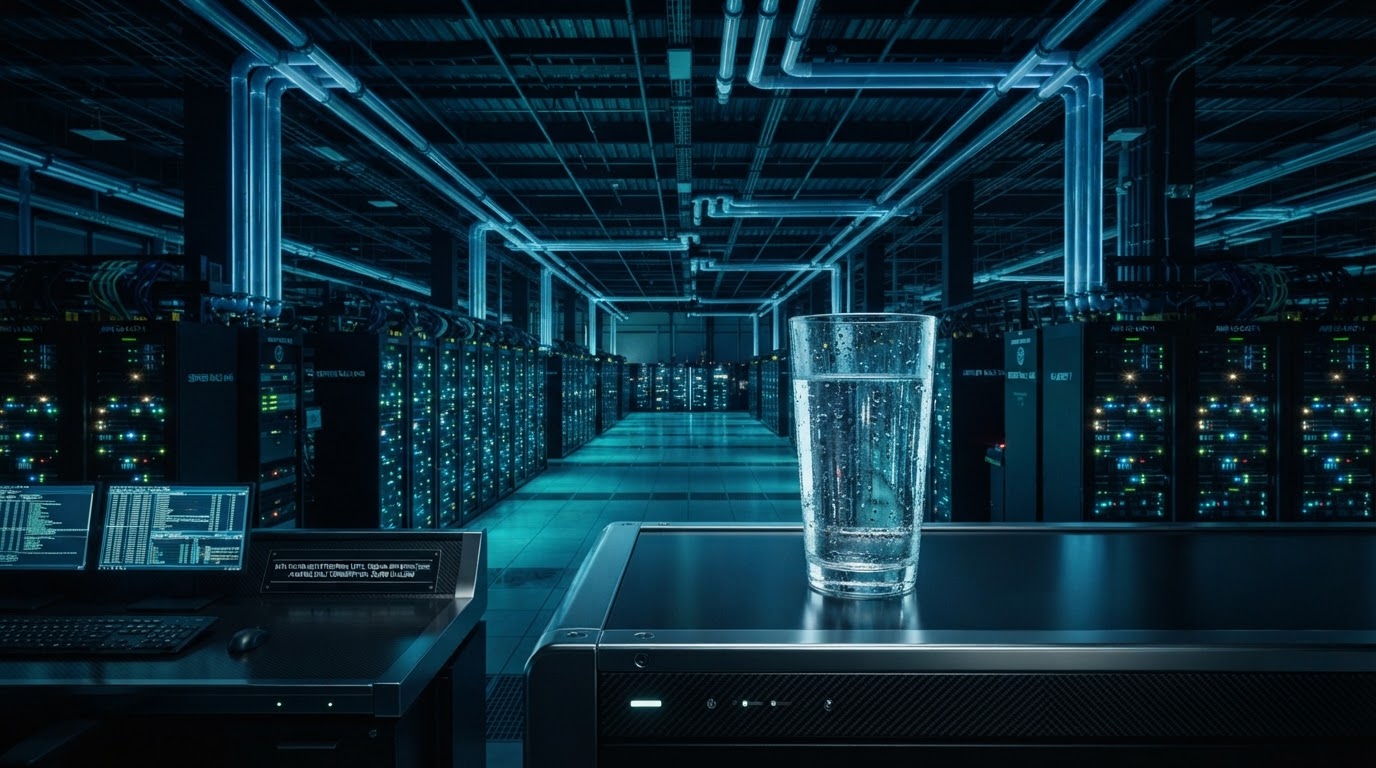
The Invisible Thirst Behind the Cloud
When you stream a movie, back up a photo, or ask an AI a question, the work happens in a data center — a warehouse-sized building packed wall to wall with servers generating enormous heat. To keep those servers from cooking themselves, the buildings are cooled, and the cheapest, most effective cooling at scale uses water.
Evaporative cooling towers — the same technology that cools power plants — pull in thousands of gallons a day and evaporate much of it into the sky. A single large data center can consume anywhere from one to five million gallons of potable water a year, and the hyperscale facilities coming online now drink far more. That water is drawn from the same municipal supply your kitchen tap depends on. The cloud is not weightless. It has a water bill, and increasingly, you're helping pay it.
What makes this hard to see is that the water never touches your property. It's consumed miles away, behind fences, in facilities most homeowners couldn't point to on a map. But the supply it draws from is shared, finite, and aging — and the math of more demand on the same system always lands somewhere.
Where the Cost Actually Lands
When a utility commits more treated water to industrial users, two things happen, and both reach your home. First, the utility raises rates to cover the added treatment capacity and the infrastructure to deliver it — and ratepayers, not data centers, absorb most of that increase in the fine print of the monthly bill. Second, the added draw stresses a distribution network that was built decades ago for a fraction of today's load.
That stress shows up as pressure. A grid pushed harder to deliver more water to more users runs at higher pressures and more frequent surges. Those surges travel the main lines, cross your meter, and arrive inside your home — where they quietly hammer the part of the system no utility maintains: your under-slab lines, your valves, and your fixtures. A data center's cooling demand in another part of the city can shorten the life of the pipe beneath your slab. That's not a metaphor. It's hydraulics.
The same deferred-maintenance incentive that governs the three big water brands governs the utilities that serve the data centers. Maintenance that would protect the grid for thirty years gets weighed against the cost of patching it for the next quarter. The grid ages. The data centers grow. And the homeowner at the end of the line pays for both, once on the bill and once in the basement.
AI Is Making It Worse, Fast
The rise of large-scale artificial intelligence has put data center water demand on a steep upward curve. AI workloads run hot and dense, and the cooling demand per rack has climbed with them. Communities across the country are watching water tables drop and utility allocations tighten as new facilities come online, often faster than the local grid can absorb them.
For a homeowner, this is the clearest sign yet that the municipal supply you rely on is no longer a quiet, stable background fact. It is a contested resource, and the entities contesting it have more lawyers and more political weight than any single household. You cannot out-lobby a hyperscaler. You can, however, make the part of the system you own resilient enough that the strain upstream doesn't become a flood downstream.
What Owning Your Water Supply Looks Like Against This
If the shared supply is going to be pressured, surcharged, and strained by demand you can't control, the rational response is to harden the part you can. That means testing your pressure and installing a pressure reducing valve so a grid surge doesn't translate into an under-slab failure. It means sleeving your under-slab water supplies so that if the strain finally does break something, the leak is contained and scheduled — not a five-figure breakout.
It means a whole-home filter, because when the utility over-treats to meet surging demand, the chemistry at your tap shifts and your fixtures and your family drink the difference. It means knowing your shutoff, because a pressure event from an over-stressed grid can come with no warning. None of these moves reform the data center. All of them protect the home from the consequences of it.
The Bigger Picture: Independence, Not Isolation
Pointing at data centers isn't about villainizing technology — it's about honesty. The people who benefit from the cloud and the people who pay its hidden water bill are increasingly the same people, and the homeowners footing that bill deserve to know it. Knowing is the first step toward owning.
Real water independence isn't going off-grid. It's making deliberate choices so that the parts of the system you control — your supply line, your pressure, your filtration, your under-slab lines — are robust enough to absorb the shocks created by the parts you don't. A home built that way shrugs off a grid strain that floods its neighbor. That's the whole point of owning your water supply in a world where demand is climbing and the grid isn't getting younger.