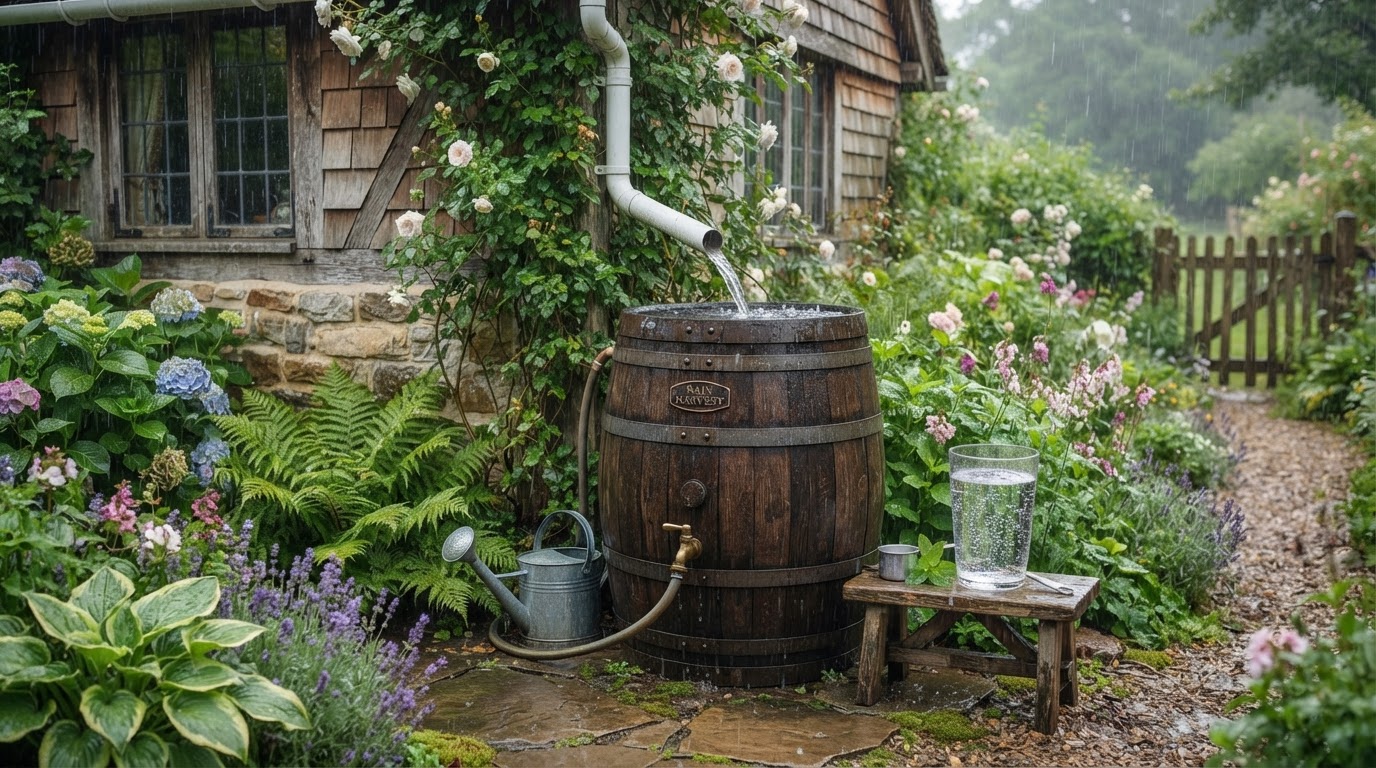
The Soft Water That Falls Free
Before there were utilities, there was rain. It's the original soft water — nearly free of the calcium and magnesium that scale fixtures, cloud glass, and shorten the life of everything from irrigation emitters to water heaters. When it falls on your roof, it arrives cleaner and gentler than anything that will ever come out of your tap, and it does so whether you catch it or not. The only question is whether you let it run down the storm drain or put it to work.
Rainwater harvesting is the deliberate act of catching that water, storing it, and using it. It's one of the oldest water-management practices on earth, and in much of the world it's completely ordinary. What's changed is that it's now also one of the most rational responses a homeowner can make to rising rates, aging infrastructure, and a grid straining under industrial and data-center demand.
The appeal is simple and hard to argue with: free water, soft water, and a reserve you control. The utility can raise the rate, but it can't raise the price of rain. It can interrupt supply, but it can't stop a storm. And when the grid is strained, the homeowner with a tank full of soft water is the one still watering the garden and flushing the toilets.
The Math of What Your Roof Already Catches
The numbers surprise most homeowners. Roughly 0.62 gallons of water falls on each square foot of roof per inch of rain. A modest 2,000-square-foot roof in a region averaging 30 inches of rain a year catches about 37,000 gallons — most of it currently sent straight to the storm sewer. Even accounting for first-flush losses and system inefficiencies, that's a meaningful water supply you're currently letting escape.
Where that water goes matters. Irrigation is the obvious first use — plants thrive on soft, chlorine-free rainwater in a way they simply don't on treated tap water. But with proper filtration and disinfection, harvested rainwater can serve flushing, laundry, cooling-tower makeup, and even potable use. The more demand you shift onto captured rain, the less you buy from a utility whose rates only travel in one direction.
This is the part that turns rainwater harvesting from a green gesture into a financial decision. Every gallon you catch is a gallon you didn't pay for, drawn from a source that's immune to rate hikes, boil notices, and the surges an over-stressed grid sends into your pipes. Over years, that's real money and real resilience.
Building a System That Lasts
A sound harvest system has a few core parts, and none of them are exotic. Gutters and downspouts collect the water. A first-flush diverter discards the initial dirty runoff that washes dust and debris off the roof. A screen or filter keeps leaves and grit out of the tank. The tank itself — sized to your roof, rainfall, and usage — stores the water. A pump or gravity feed moves it to where it's needed, and a simple overflow path handles the big storms.
The two things that determine whether a system gives you years of trouble-free water or becomes a neglected eyesore are filtration and maintenance. Keep the gutters clean, service the first-flush diverter, and protect the tank from sunlight and debris, and the water stays fresh and the system stays simple. Ignore it, and any stored water system will teach you why maintenance matters. This is no different from the rest of your plumbing: the owner who maintains on a schedule is the owner who never faces the catastrophic bill.
Start with the use that gives you the most value for the least complexity — usually irrigation — and expand as the system proves itself. There's no prize for installing the biggest tank on day one. There's real value in building the habit of catching what falls, then growing into it.
Why Soft Water Is the Hidden Win
The independence story is obvious, but the soft-water story deserves its own attention. Because rainwater carries almost no dissolved minerals, it doesn't scale. That means irrigation emitters don't clog, fixtures don't cloud, and appliances that hate hard water — from humidifiers to evaporative coolers to water heaters — run cleaner and last longer. You're not just getting free water; you're getting better water for the uses where mineral content does the most damage.
This is exactly why rainwater and condensate catchment pair so well: both deliver naturally soft water at different times of year, covering your non-potable demand with a quality the utility can't match at any price. Layered together, they form a soft-water reserve that protects your fixtures and appliances while it shrinks your bill.
Owning your water supply isn't only about avoiding the utility. It's about getting water that's actually better for the parts of your home that use it most. Rainwater is the clearest example: the best water on your property is the water that falls on it for free.
Independence as a Stack, Not a Switch
No single move makes a homeowner independent. Independence is a stack — rainwater harvesting, condensate catchment, a pressure reducing valve, sleeved under-slab lines, whole-home filtration, labeled shutoffs — each one a small, sensible decision that compounds over years. Rainwater is the keystone of that stack because it's the move that produces the most water, the softest water, and the most visible leverage against the utility bill.
The homeowner who catches rain, catches condensate, hardens their pressure, and sleeves their under-slab lines isn't off-grid. They're simply no longer entirely at the mercy of a single pipe, a single rate, and a single point of failure. When the grid strains, they have options. When rates rise, they have a buffer. When a pipe finally ages, the consequence is small and theirs to manage — not a five-figure surprise.
That's the whole idea behind Cobra Service Co. We spent two decades watching which homes hold up and which ones don't, and the ones that hold up are the ones whose owners took the water seriously. Rainwater harvesting is one of the oldest, smartest ways to do exactly that.