The Idea Hiding in Your Utility Bill
If you read your power bill the way an electrician does, there's a pattern most homeowners never look at twice. The price you pay for a kilowatt-hour is not flat across the day. It's cheaper when demand is low — overnight, early morning — and it climbs sharply when demand peaks. In a growing number of markets, the afternoon price isn't just higher; it's dynamically priced, meaning the utility raises it in real time as load climbs. The steepest climb lands right around 5pm, when industry is still running, air conditioning is maxed out, and everyone gets home and turns everything on.
The thing nobody tells you is that the power itself is identical. A kilowatt-hour at 2am and a kilowatt-hour at 5pm are the same physical quantity of energy. The only difference is what the utility charges for it at the moment you pull it. So the question a battery bank answers is almost embarrassingly simple: what if you pulled it when it was cheap and spent it when it was expensive?
That's the whole idea. Store energy when the grid is cheap, hold it in a battery, and run your home off the battery when the grid is expensive. The difference between the cheap price and the expensive price is the savings — and unlike a generator, which only runs when the power is out, a battery bank is working for you every single day. It's not emergency equipment that sits idle. It's a tool that earns its keep 365 days a year and then happens to also keep the lights on when the grid fails.
What a Backup Battery Bank Actually Is
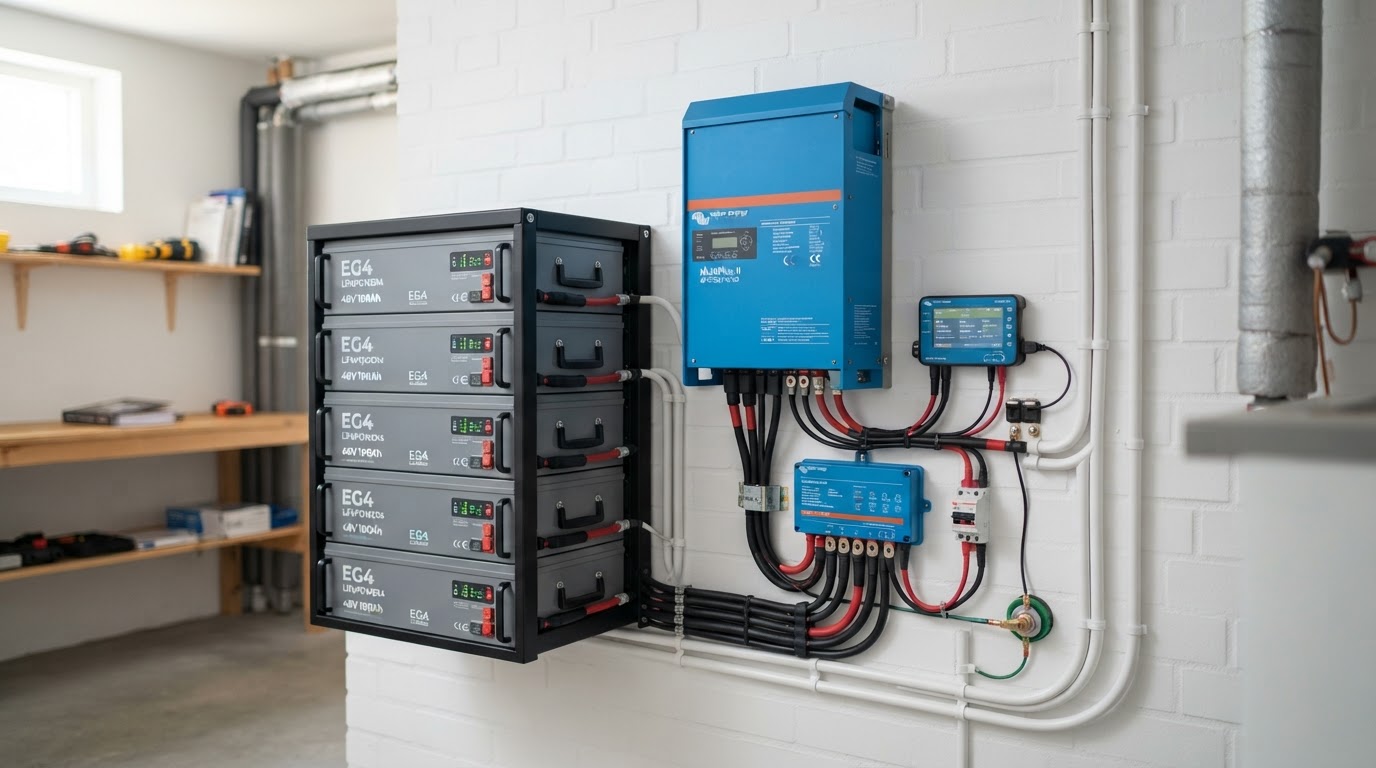
Strip away the marketing and a backup battery bank has four real parts, and it's worth knowing each one because each does a specific job. The first is the battery itself — the cells that hold the energy. In a modern, well-built bank that means lithium iron phosphate, LiFePO4, not the lead-acid chemistry you'd find in an old car battery or a cheap backup. We'll get to why that matters in a minute.
The second part is the battery management system, or BMS. This is the brains of the bank. It watches every cell's voltage, temperature, and charge state, and it prevents the two things that kill batteries — overcharging and over-discharging. A lithium bank without a good BMS is a fire waiting for a reason; a lithium bank with a good BMS is a system that runs for thousands of cycles safely. The BMS is the difference between a battery that lasts a decade and one that swells up in two years.
The third part is the inverter-charger. Batteries store direct current, DC. Your house runs on alternating current, AC. The inverter-charger is the translator in both directions: it takes grid AC and converts it to DC to charge the battery, and it takes battery DC and converts it back to clean AC to run your home. A quality inverter-charger — we use Victron, and we'll explain why — also shapes the output so it's a clean, stable sine wave that won't damage electronics the way a cheap modified-sine inverter can.
The fourth part is the automatic transfer switch, the ATS. This is the component that makes the grid-down story real, and it deserves its own section. For now, know that the ATS is the traffic cop that decides, moment to moment, whether your home is pulling from the grid or from the battery — and it does it without you touching a thing.
How the Math Works: Store Cheap, Use Expensive
Here's the savings mechanic in plain terms. During the cheap hours — overnight and off-peak — the inverter-charger pulls power from the grid and fills the battery. The battery stores it. Then, as the afternoon rolls in and the dynamic price climbs toward the 5pm peak, the system flips: instead of buying expensive power from the grid, your home runs off the battery you filled when power was cheap. When the peak passes and prices drop again overnight, the bank refills. Repeat, every day.
The savings is the gap between those two prices, times the amount of energy you shift. If a kilowatt-hour costs, say, a few cents overnight and several times that during the peak, every kilowatt-hour you spend out of the battery instead of off the grid is money that stays in your pocket. It's not a rebate and it's not a government program. It's just not paying the premium price for the same energy.
We call it legal arbitrage, and that's exactly what it is. Arbitrage is the act of buying something where it's cheap and using it where it's expensive, and the reason it's legal is that you're not tricking the market — you're just choosing when to draw the power. The grid doesn't care whether you use a kilowatt-hour at 2am or 5pm from its end. It only cares what it charges you at the moment you pull it. The battery bank lets you choose the cheap moment. That's the whole trick, and it's the whole reason the monthly math works.
On a typical build, the bank costs a fixed monthly amount and saves a larger fixed monthly amount by avoiding the peak. The difference is a net positive every month — the system costs less to run than it saves you. That's the part most people don't believe until they see the numbers, because most backup equipment only costs you money. A generator buys you nothing but peace of mind, and then burns fuel whether the power is on or not. A battery bank pays you back while it's keeping you safe.
Why Lithium, Not Lead-Acid
This is the part where the chemistry genuinely matters, and it's not marketing. Lead-acid batteries — the old technology — are cheap up front but they wear out fast. They can't be deeply discharged without damage, so you only get to use maybe half of what you paid for. Their round-trip efficiency is low, meaning a chunk of the energy you put in is lost as heat on the way back out. And their cycle life — the number of charge-discharge cycles before they degrade — is measured in the low hundreds.
Lithium iron phosphate, LiFePO4, is the opposite trade. It costs more per kilowatt-hour up front, but it discharges deeply without damage, so you get to use nearly all the capacity you paid for. Its round-trip efficiency is high, so more of the energy you store comes back out as usable power. And critically, its cycle life is measured in the thousands — meaning a well-built lithium bank runs for years of daily cycling before the capacity meaningfully drops. When you're cycling a battery every single day to capture peak arbitrage, that cycle life is the difference between a system that pays itself back and a system that wears out before it does.
There's a safety angle worth saying plainly. LiFePO4 is the more thermally stable lithium chemistry — it's far less prone to thermal runaway than the lithium chemistries you read about in the news. A properly managed LiFePO4 bank with a quality BMS is the reason a battery backup can live in a garage or utility room without being a worry. It's not the cheapest lithium, but it's the one that belongs in a home.
The Automatic Transfer Switch: Where Grid-Down Independence Starts
Everything we've covered so far is about the money. This section is about the other half of why a battery bank matters — what happens when the grid actually fails. And the component that makes that work is the automatic transfer switch.
Here's what an ATS does in practice. It constantly monitors the grid. As long as the grid is healthy, your home runs on grid power (or, during the peak, on battery power under the system's control). The instant the ATS detects that the grid has dropped — a voltage sag, a frequency drift, a full outage — it disconnects from the grid and connects your home's essential loads to the battery, through the inverter, in milliseconds. There's no manual switch to throw. There's no scrambling for a flashlight and a fuel can. The lights might blink, and then they're on, running off the battery, and the refrigerator is still cold and the well pump still runs and the internet still works.
The reason this is different from a portable generator is speed and silence. A portable generator has to detect the outage, start its engine, warm up, and then take the load — that's seconds to tens of seconds of darkness, plus noise, plus fuel. An ATS on a battery is a solid-state switchover in milliseconds. The lights don't even go off in most cases; they flicker and keep going. And the battery makes no noise and burns no fuel while it runs. For a short outage it just rides through. For a longer one, it buys you hours of clean, silent power to keep the essentials alive — and if you've got solar feeding it, it can run a lot longer than its stored capacity alone.
That's the independence half. The same hardware that's saving you money every day is, without any extra effort on your part, also standing guard against the grid going down. You don't have to choose between a money-saver and a backup. The battery bank is both, and the ATS is the part that makes the backup half automatic.
What a Battery Bank Won't Do (and Why Sizing Is Everything)
Here's the honest part, because overselling a battery bank is the fastest way to lose a homeowner who trusted you. A battery bank is not a whole-house generator that runs everything indefinitely. It has a finite capacity, measured in kilowatt-hours, and it can only power what its inverter can handle at once. If you size it to run the air conditioner, the well pump, the oven, and the electric dryer all at the same time during a three-day outage, you'll either need a very large bank or you'll be disappointed.
The right way to think about it is in tiers. The essentials — lights, refrigerator, well pump, internet, medical devices, a few circuits — are what a sensibly sized bank carries through an outage comfortably. A bigger bank, or one backed by solar that recharges it during the day, carries more. A bank sized for full whole-house backup is a different, larger conversation. The point is that the bank has to be matched to the loads you actually want to keep, or the 'runs when the grid is down' promise doesn't hold.
This is exactly why an assessment exists instead of a one-size-fits-all price. The load matters. The house matters. The local rate structure matters — arbitrage only saves money where there's a real peak price to avoid, and the size of that peak decides how fast the bank pays back. A system designed for your actual usage and your actual rate plan is the only one that delivers both the monthly savings and the grid-down backup we're describing. Sizing it blind is how you end up with a battery that either can't carry the load or costs more than it saves. Sizing it right is how it earns its keep.
Why Victron, and Why It Matters to the Mechanics
We build our battery bank around Victron hardware, and there's a mechanical reason, not just a brand preference. The inverter-charger and the ATS are the components that decide whether your lights stay on and whether your savings are real. A cheap inverter produces a dirty waveform that can shorten the life of motors and electronics. A cheap transfer switch is slow, can fail to isolate from the grid properly, and is the kind of corner that costs you the whole point of having a backup. The component that has to work flawlessly every day for a decade is the one you don't cut.
Victron's inverter-chargers are built for exactly this daily-cycling, grid-interactive duty. They produce a clean, stable sine wave, they switch cleanly between charging and inverting, and they're paired with transfer switches designed to isolate properly and switch fast. When the whole value of a system rests on the hardware performing reliably for years, the inverter and the switch are where the reliability lives — and that's the part we won't compromise on. It's the difference between a battery bank that's a real piece of your home's infrastructure and one that's a gadget.
Putting It Together: The Stack That Pays You Back
So here's the whole picture in one breath. A backup battery bank stores power when the grid is cheap and spends it when the grid is expensive — that's the monthly savings, and it's the part most people never believe until they see it on the bill. The same bank, through an automatic transfer switch, rides through grid failures in milliseconds and keeps the essentials running in clean, silent, fuel-free silence — that's the independence, and it's working whether you're thinking about it or not. And because it's lithium with a quality BMS and a quality inverter, it does both for thousands of cycles instead of wearing out in the first year.
It's not a generator, and it's not trying to be. A generator is emergency equipment that burns money while it sits idle. A battery bank is infrastructure that earns its keep every day and then, when the day you hoped wouldn't come does come, it's already running. That's the mechanic in one line: it saves you money on the good days so that it's already on the job on the bad ones.
If you've read our water independence work, this is the same philosophy applied to power. You don't rent your resilience from a utility whose first duty is to shareholders. You own it, you maintain it, and you let it pay you back. The grid is a convenience. The battery is the independence underneath it.