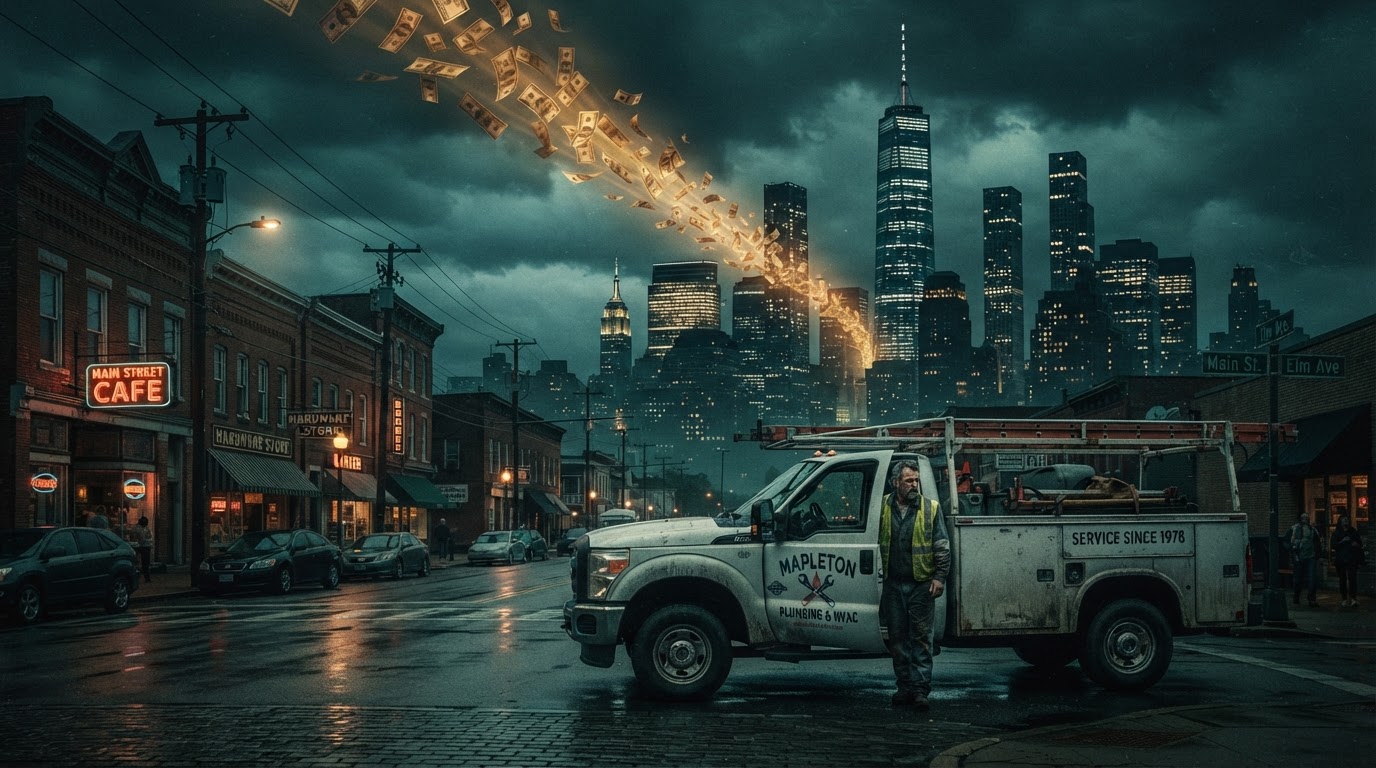
The Truck Looks the Same. The Owner Changed.
The plumbing or HVAC truck pulling into your driveway still wears a name you've trusted for years. The logo is familiar, the colors are the same, and the technician who rings your doorbell is probably a hard-working local person you'd be glad to have a beer with. But somewhere between the time you first learned that name and today, the company that owns it quietly changed hands — and not to another local family.
Over the last decade, a wave of private-equity rollups has swept through the home-service trades. Investment funds buy up respected regional brands, fold them into a holding company, standardize the back office, and push for growth and margin. The customer-facing name often stays exactly the same, deliberately, because the brand's local goodwill is the most valuable asset being acquired. You trust the name. The name now answers to a spreadsheet.
This isn't a rumor or a fringe theory — it's a documented, public strategy. The trades were labeled one of the most attractive 'fragmented industries' for consolidation precisely because they're full of beloved local brands run by aging owners looking for an exit. To a fund, that goodwill is an undervalued asset ready to be acquired, scaled, and flipped. To your town, it's a piece of the community walking out the door.
Follow the Money Out of Town
Here's what most homeowners never see: the economics of a rollup are designed to extract, not to circulate. When your local plumber was owner-operated, a meaningful share of every dollar you paid stayed in your community — the owner's mortgage, the shop's rent, the local parts supplier, the Little League sponsorship, the technician who lived three streets over. Money paid to a local business recycles locally. That's the whole point of a hometown economy.
When the brand is owned by a holding company backed by multinational funds — including ones tied to Wall Street giants like BlackRock — the math flips. A slice of every service call heads out of your town as profit, management fees, and debt service on the loans used to buy the company in the first place. Rollups are frequently loaded with debt at acquisition, and servicing that debt comes from... your repair bill. The money that used to pay a local mortgage now services a portfolio held by investors you'll never meet, in New York and increasingly overseas.
You don't get a worse repair because of this. You get a more expensive one, and the premium quietly leaves town. Multiply one service call by a thousand homes, by a hundred towns, by the dozens of brands a single rollup absorbs, and you're watching a quiet, structural transfer of wealth out of American communities and into capital markets. Nobody votes on it. Nobody announces it. The trucks just keep showing up.
Champion, Apex, Southern Air — and the Rollup Playbook
Names like Champion, Apex, and Southern Air sound like exactly what they were built to sound like: hometown, dependable, the kind of company your neighbor recommended. That's the genius and the sadness of the rollup playbook. The brand was built on local trust — often over generations — and that trust is precisely what makes it a prime acquisition target. A fund doesn't buy a company; it buys the community's goodwill and the right to monetize it.
The pattern after acquisition is remarkably consistent. Back-office functions centralize, often out of state. Customer service moves to a call center. Pricing standardizes upward to hit margin targets. Sales quotas and upsell scripts replace the owner's judgment. The experienced technicians who trained under the original owner — the real talent pool — get squeezed, and many eventually leave for independent shops or leave the trade entirely. The company keeps the name and the trucks; it slowly loses the people and the culture that made the name worth something.
That erosion of the local talent pool is the part that hurts longest. A trade is only as good as the people in it, and a town's plumbing, HVAC, and electrical talent is built apprentice by apprentice over decades. When a rollup harvests that talent for short-term margin and the best hands drift away, the whole community ends up a little worse off — and the next generation of homeowners pays for a thinner bench of skilled tradespeople, all while the holding company reports record EBITDA.
Why It Shows Up in Your Home
You might ask what any of this has to do with the pipe under your slab or the water heater in your closet. More than you'd think. A company managed for margin rather than craft has a structural incentive to push replacement over repair, because replacement bills are bigger and the upsell path is scripted. The line that could be cleared gets replaced. The fixture that could be rebuilt gets swapped. The honest 'this'll give you five more years' becomes the panicked 'you're living on borrowed time.'
That's not a knock on the technician in your home — most of them are good people doing their best inside a system that sets the targets for them. It's a knock on the incentive structure. When the owner of the company answers to investors expecting 20% margins, the recommendation that protects the homeowner's wallet is in tension with the recommendation that protects the portfolio. The further the ownership gets from your town, the more that tension resolves against you.
This is exactly why we built Cobra Service Co. the way we did. We're not a rollup. We're not a holding company. We're two brothers who answer our own phones, who still get under houses, and who made a pact that if a line can be cleared we clear it and if a pipe can be saved we save it. That kind of honesty only survives when ownership is local, present, and planning to stay.
The Talent Drain Nobody Talks About
The slowest, deepest cost of the rollup wave is what it does to the trades themselves. The best plumbers, HVAC techs, and electricians didn't learn their craft in a spreadsheet — they learned it under a master who cared enough to teach them, in a shop where quality was the brand. When those shops get acquired and squeezed, the masters retire early, the apprentices lose their mentors, and the institutional knowledge that took a community decades to build walks out the door over a single earnings cycle.
That's why our first Pay It Forward Apprentice Academy started in Oklahoma City back in 2010 — because we could see the talent drain coming before the rollups even had a name for it. You don't replace a generation of skilled tradespeople with a marketing budget. You replace it by training the next one, hands-on, the hard way, the way it's always been done. Every brand Cobra Service Co. runs — Alamo Rooter, Austin Rooter, Okie Rooter, Fort Worth Rooter — exists in part to keep real tradespeople working in the towns that raised them, instead of funneling the proceeds to a fund in another time zone.
What a Homeowner Can Actually Do
You can't unwind private equity, and you shouldn't have to. But you can make two choices that matter. First, ask who owns the company before you hire them. A genuine local owner-operator will tell you proudly; a rollup will change the subject or bury the ownership three holding companies deep. Prefer the hands that live where you live. The money you pay them stays in the place you both call home.
Second, own more of your home's systems so you need the trades less often and on your terms. Sleeve your under-slab water supplies so a leak is a contained repair, not a five-figure emergency that plays right into an upsell script. Know your shutoff valves, test your pressure, flush your water heater, and maintain on a schedule you set. The more of your home you genuinely own and understand, the less leverage any company — local or Wall Street-backed — has over you when something does go wrong.
The big picture is simple and worth saying out loud: a town is only as strong as the tradespeople who serve it, and the trades are only as honest as the people who own them. Keep the money local when you can, keep the ownership of your home's systems local when you can, and the rest takes care of itself. That's the whole idea behind Cobra Service Co. — and it's why we'll never be for sale.