What 'Normal' Actually Means
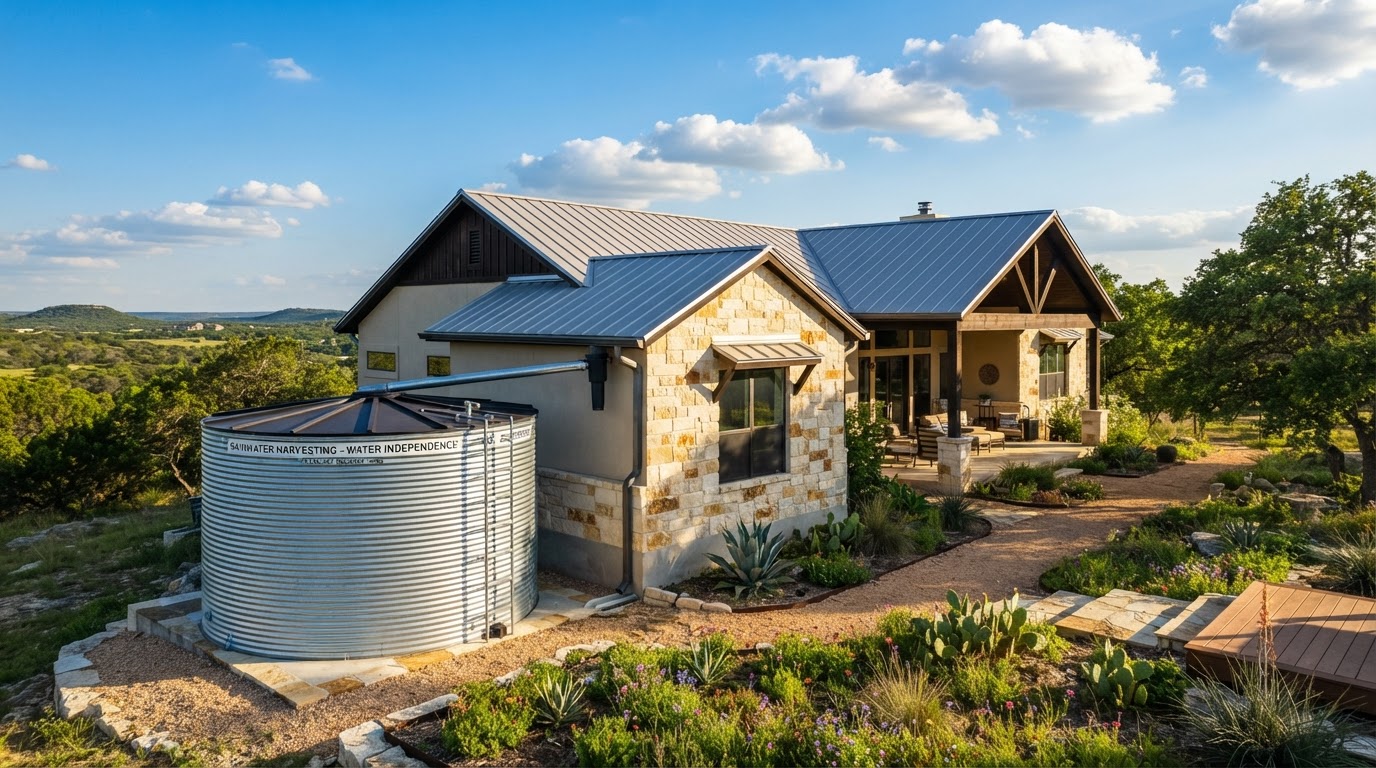
Travel through parts of the Caribbean, rural Australia, the Greek islands, or the Texas Hill Country, and you'll find homes with a cistern as unremarkably as you'd find a furnace in Minnesota. The roof catches rain, the water flows into a tank, a filter and pump deliver it to the tap, and the household uses it without thinking about it. Nobody calls it survivalism. Nobody calls it alternative. It's just how a house works.
In those places, 'normal' was shaped by scarcity or distance — where a municipal line was never coming, or where dry seasons taught generations to store what the sky gave freely. The cistern isn't a statement. It's a sensible answer to a real question: where does your water come from when the grid isn't the answer?
What's striking is that the people who grew up with cisterns rarely think of themselves as independent or off-grid. They think of themselves as normal. And they're right. The question for American homeowners is why we decided a single pressurized pipe from a utility was the only acceptable version of normal — and what that decision has cost us.
How American 'Normal' Was Built
For most of the last century, American 'normal' meant centralization: a utility treats the water, a grid delivers it, a meter measures it, and a bill collects for it. It was sold as progress, and in many ways it was — reliable, treated water on demand is a genuine public good. But centralization also quietly traded something away: the expectation that a household would know, store, or control any of its own water.
That trade only looks free while the system is cheap and stable. As rates climb, infrastructure ages, and demand from industry and data centers strains the grid, the cost of having outsourced the entire question becomes visible. A homeowner with no buffer has exactly one option when the utility raises the rate, issues a boil notice, or surges the pressure: pay it, and hope the pipe holds.
Rethinking normal isn't rejecting treated municipal water. It's refusing to treat a single pipe as the only leg the stool stands on. The rest of the world learned long ago that a home with more than one way to get water is simply a more resilient home. We forgot, and we can remember.
What a Cistern Actually Adds
A cistern is a buffer. It stores water when it's plentiful — or free, from the sky — and makes it available when the utility supply is expensive, restricted, or unreliable. Even a modest tank converts a household from a purely dependent consumer into one with a reserve, and that reserve changes how you experience every other part of your water system.
With a cistern, a rate hike isn't an emergency — it's a signal to lean on stored water. A boil notice isn't a scramble — it's a switch. A pressure surge from an over-stressed grid meets a tank that absorbs and smooths it before it reaches your fixtures. The cistern doesn't replace the utility; it gives you leverage against it, the same way a savings account gives you leverage against a sudden bill.
And because rainwater and condensate are naturally soft, the water you capture arrives without the mineral load that hardens fixtures and shortens the life of your pipes. You're not just storing water. You're storing better water, captured on your terms.
Rethinking the Stigma
In America, captured water still carries an unfair stigma — as if storing rainwater is something only doomsday preppers or off-grid eccentrics do. That's marketing, not engineering. The same logic that made a cistern normal in Bermuda or Barbados makes it sensible in Austin or Oklahoma City: water is a finite, valuable resource, and the household that holds some of its own is simply more prepared.
The shift is mostly mental. Once you stop treating the utility as the only legitimate source, a whole set of sensible questions opens up: how much roof area do I have, how much rain falls, what would a modest tank buy me in resilience, how do I keep it clean and filtered. None of these are extreme. They're the same questions a homeowner in the Caribbean answers without a second thought.
Rethinking normal means giving yourself permission to value what falls on your roof. The independence isn't symbolic. It's the difference between a home that can only get water one way and a home that can get it two.
Starting Small, Owning the Idea
You don't install a 10,000-gallon cistern on day one. You start with the mindset, then the math: your roof area, your local rainfall, and what a tank sized to your real usage would buy you. Even a few hundred gallons of captured rainwater offsets irrigation, flushes toilets, and gives you a soft-water reserve the utility can't price or interrupt.
From there, you treat it like the rest of your water system: filter what you use, test it seasonally, maintain the gutters and first-flush diverter, and grow the capacity as the value proves itself. This is the same patient, owner-controlled approach we preach for under-slab lines and pressure valves. Independence is built one sensible decision at a time, not in a single dramatic gesture.
The goal isn't to leave the grid. It's to stop being entirely at its mercy. A cistern is how a homeowner reclaims a piece of normal that most of the world never gave up.